Meet the 2026 Senior Design Teams
Senior Design is a year-long engineering course that provides graduating seniors with a dynamic opportunity to learn by doing, stand out professionally, and collaborate. Seniors work in interdisciplinary teams of 3-6 students and are mentored by experienced engineering faculty and project sponsors throughout the process. This hands-on experience offers students firsthand exposure to working with potential future employers while completing real-world projects. Aside from the technical skills, this course also helps students develop and refine their collaborative teamwork abilities while delivering impactful project results for their sponsors.
Schedule
Senior Design Pitches and Q+A
8:30 AM - 10:30 AM
ECS 510Senior Design Poster Demonstration
10:30 AM - 1:00 PM
ECS First Floor and Second Floor

Advita Ortho Team
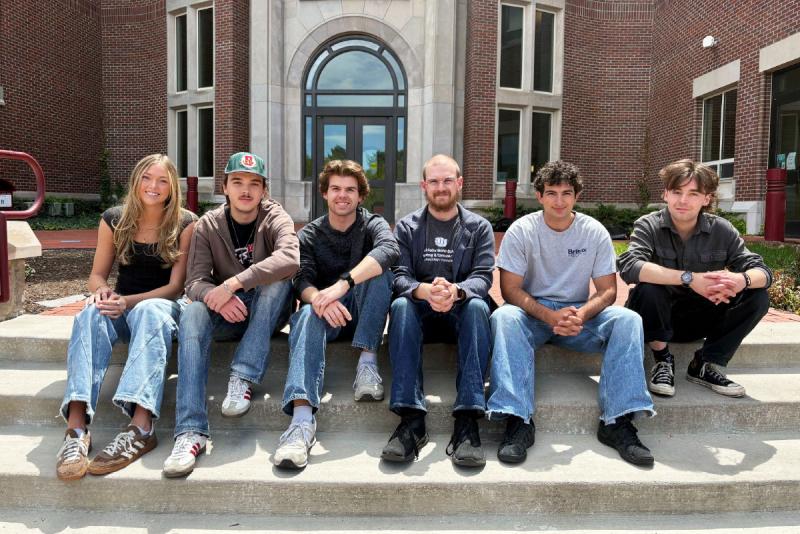
Automatic Hammer Mechanism for Total Hip Replacement Surgery
Project Sponsor: Advita Ortho
Team Members: Solomon Anderson, Jack Burson, Mason Crocco, Ava Reynolds, Aiden Serratoni, Orestis Strongylos
-
Read Project Information
Currently, the most physically intensive part of total hip replacement surgery is the femoral broaching process, where surgeons must hammer in a series of broaches into the patient's femur to widen the femoral canal. Performing this process manually using a hammer has lead to surgeon fatigue, injuries, and even unintended femoral fractures, with as much as 66.1% of surgeons reporting broaching related injuries during their career, leading Advita Ortho to task our team with developing an automatic hammer mechanism to streamline this process.
Our solution acts as a purely mechanical attachment to existing operating room drills, eliminating the need for a battery-operated system such as devices already on the market. Instead, our system uses a barrel cam spring mechanism to use the Stryker drill’s rotary output to compress a spring, which when released, provides repeated high impact energy to drive in the surgical instrument. The final design should be manufactured from sterilizable materials to be suitable for use in an operating room and tested and verified in a mock OR setup using saw bone samples to verify the system’s real-world viability.
Our team hopes that our design may enable improved accessibility and reduced complexity of automatic femoral broaching systems by offering a mechanical alternative to existing products, improving the lives of surgeons and patients alike and streamlining the widespread need for hip replacement surgeries.
Arsenal Nexus Team
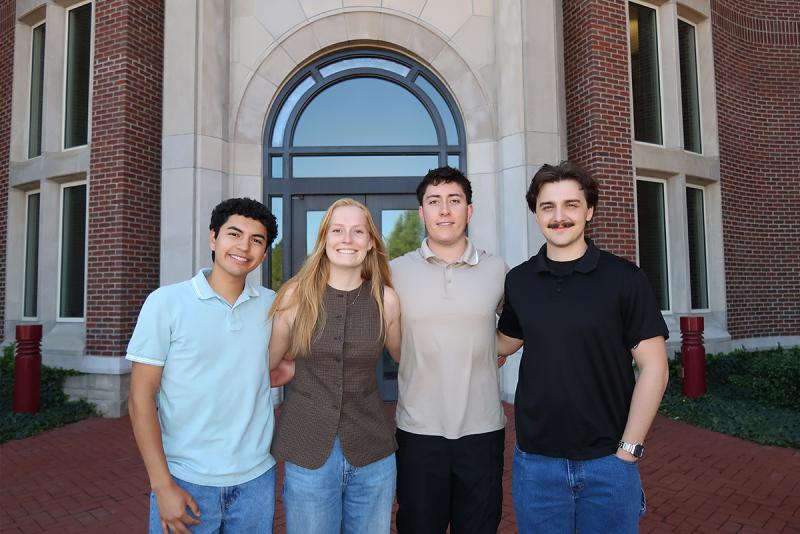
It’s a Bird, It’s a Plane, No It’s Our Drone (Reconfigurable Quadrotor)
Project Sponsor: Arsenal Nexus
Team Members: Alexis Romo, Twyla Borck, Grant Miks, Diego Armendariz
-
Read Project Information
Unmanned aerial vehicles (UAVs) are widely used in applications such as search and rescue, infrastructure inspection, and military operations; however, traditional quadrotor designs are limited by their fixed geometry. This often forces a tradeoff between size, maneuverability, and payload capacity, making it difficult for a single drone to operate effectively in both open environments and confined spaces. This project addresses limitations by developing a reconfigurable quadrotor capable of adapting its structure during flight to better fit its surroundings.
The proposed system is a quadrotor with arms that can change orientation between a standard X configuration and a compact, parallel configuration that reduces its overall footprint. This transformation is achieved using a servo-driven mechanical system integrated into the frame. A Pixhawk 6X flight controller, paired with an Arduino interface, interprets a user command and actuates the reconfiguration. To maintain stability, the control system switches between different PID gain sets for each configuration, accounting for changes in system dynamics.
Unlike conventional drones designed for a single operating condition, this system introduces adaptability without sacrificing payload capacity or overall size. By temporarily reducing its footprint, the drone can access tighter spaces such as narrow corridors, cluttered inspection sites, or obstructed rescue areas, then return to a more stable configuration for standard flight. This increases mission flexibility while maintaining performance.
The expected impact of this work is the development of a more versatile UAV platform capable of performing multiple roles within a single mission. Applications include search and rescue, infrastructure inspection, and other environments with varying spatial constraints. More broadly, this project serves as a proof of concept for integrating mechanical reconfiguration with adaptive control systems, contributing to the advancement of flexible and efficient UAV design.
B-Braun Team
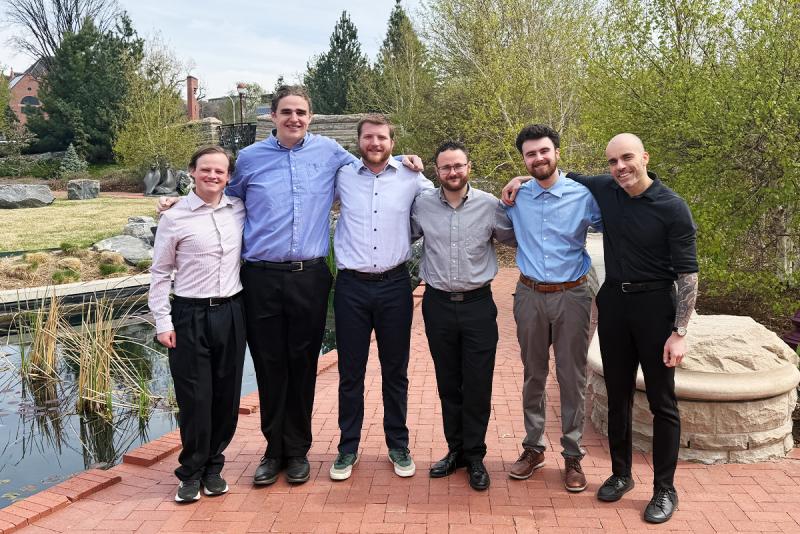
Smart Infusion Pump with Bluetooth Sensor Integration
Sponsor: B-Braun Medical Inc.
Team Members: Ali Alalwia, Calvin Ginnebaugh, Jackson Hall, Braidyn Sheffield, Jamison Stanely, Hudson Wunderlich
-
Read Project Information
Infusion pumps are critical medical devices used to deliver precise amounts of medication to patients in clinical settings. As a global medical technology company, B. Braun develops infusion therapy systems that prioritize accuracy, safety, and usability. However, many existing infusion pump systems rely on wired sensors or manual monitoring, which can create clutter, increase setup complexity, and limit real-time responsiveness. These limitations highlight the need for a more integrated and user-friendly system capable of improving both patient safety and clinical workflow.
This project presents the design and development of a smart infusion pump system with wireless sensor integration and closed-loop control capabilities. The system consists of a syringe-based infusion pump and multiple Bluetooth-enabled sensor modules, including temperature, heart rate, and flow sensors. Each sensor is battery-powered and designed with a custom enclosure, allowing for flexible placement and extended operation. Secure communication between the pump and sensors is achieved through Bluetooth connectivity combined with NFC-based pairing, enabling rapid and reliable device setup. Additional security measures, including unique device addressing and encrypted communication, help prevent interference and ensure accurate data transmission in environments with multiple devices.
The infusion pump itself incorporates a touchscreen graphical user interface, allowing healthcare professionals to easily monitor system status and interact with the device. A custom embedded system running a real-time operating system manages pump operation, processes incoming sensor data, and enables closed-loop control. This allows the system to dynamically respond to real-time patient conditions, improving the precision and safety of medication delivery. Additional safety features, such as air-bubble detection, further enhance system reliability and provide alerts to medical staff when potentially hazardous conditions are detected.
The final system demonstrates successful integration of wireless communication, embedded control, and sensor feedback into a cohesive and functional prototype. Key components include the syringe pump, embedded controller, Bluetooth communication module, NFC pairing system, and multiple wireless sensor modules. The system achieves reliable real-time communication between devices, stable operation under both wall power and battery conditions, and seamless sensor pairing for ease of use.
Blind Institute of Technology Team
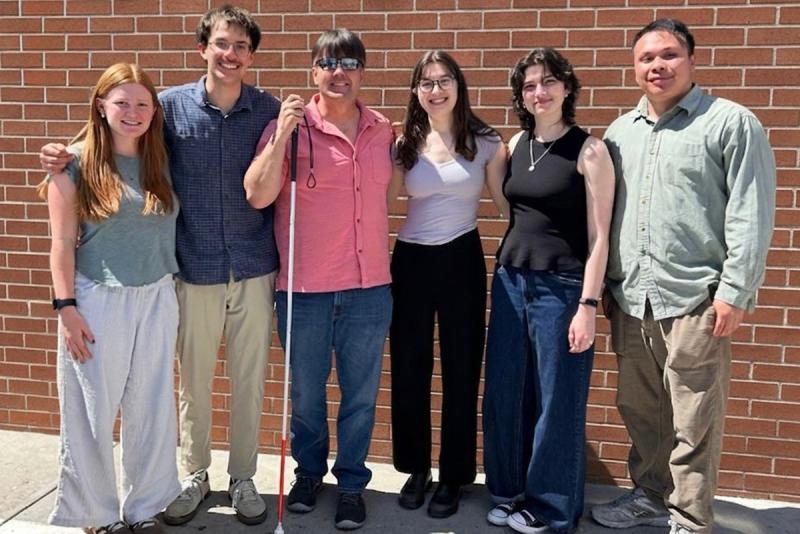
Tactile Algebra for the Visually Impaired
Sponsor: Mike Hess at the Blind Institute of Technology
Team Members: Daniel Quiroa, Iris Levey, Ivy Newman, Jeremy Trafas, Stella Jackins
-
Read Project Information
75% of visually impaired students are at least one grade behind in math, and 20% are five or more grades behind. These students struggle due to algebra’s highly visual concepts. The goal of the project is to create a tactile and auditory learning aid which allows visually impaired students to grasp the highly visual concepts of algebra.
Our accessible algebra learning system is a portable kit that a student can carry in a backpack between home and school. Designed for visually impaired students, the kit is assembled with the help of a teacher and includes a device stand, 3D-printed magnetic algebraic characters, and a magnetic workspace with three designated lines for solving multi-step equations.
Once assembled, an iOS device running the BIT Algebra app is placed in the stand. The app delivers algebra curriculum audibly via VoiceOver and prompts the student to physically build an equation using the magnetic characters. The device then uses Optical Character Recognition (OCR) to verify the student’s work. If the equation is incorrect, the app reads the detected characters back to the student, providing immediate audio feedback so they can independently correct their errors.
This project allows visually impaired students to have a tool to support learning new materials that tend to be highly visual. Our system allows rural areas to have access to a higher standard of education. This project will make STEM more accessible to visually impaired individuals, specifically ones in middle school when they usually drop out of STEM.
DU Scapula Team
Osseous Acoustic Scapular Imaging System (O.A.S.I.S.)
Sponsor: Michelle B. Sabick, PhD and Julia A. Dunn, PhD, Department of Mechanical Engineering, University of Denver
Team Members: Perrin Schneider, Will Zuzic, Isaiah Madril, Hampton Zinn
-
Read Project Information
Dislocation and instability are two major causes of implant failure following total shoulder arthroplasty. Improved measurement of scapular motion may help clinicians better understand shoulder kinematics, optimize implant position, and improve patient outcomes. Current methods for evaluating scapular movement are invasive, expensive, or use ionizing radiation. The objective of this project was to develop a noninvasive, nonionizing system capable of quantifying three-dimensional scapular position and orientation.
The resulting design, called the Osseous Acoustic Scapular Imaging System (O.A.S.I.S.), is a two-part, proof-of-concept system, consisting of an array of ultrasound probes and a biomechanical shoulder model. The ultrasound system is designed to detect and track scapular movement by measuring the distance between the scapula and the probes as the scapula moves through soft tissue. The biomechanical shoulder model acts like a human shoulder, allowing repeatable testing of the sensing system. An inertial measurement unit (IMU) mounted to the scapula provides reference orientation data to verify the scapular position detected by the ultrasound system.
This project demonstrates the feasibility of combining a biomechanical model, embedded sensing, and noninvasive ultrasound technology into a clinically relevant shoulder tracking system. The tunable soft tissue material design provides a controlled environment for evaluating ultrasound performance under idealized acoustic conditions. The anticipated impact of this work is the future development of safer and more accessible tools for research surrounding upper extremity movement and surgical planning. Continued work will focus on real-time sensor data processing, accuracy verification, and ultimately clinical use.
Enovis Team

Don’t Break a Leg: Overload Protection for Bone-Anchored Prostheses
Sponsor: Enovis
Team Members: Hawk Fugagli, Nolan Fowle, Eliot Hynes, Jackson Bolinger, Brasen Marlin, Maya Tarnowski
-
Read Project Information
Above-the-knee amputees who use osseointegrated prosthetic systems such as Enovis’s AKA POP device, have their prosthesis directly anchored to the femur which provides comfort, mobility, and user confidence. However, this direct skeletal connection introduces a critical safety concern: the risk of prosthetic damage and femur fracture during high-load events such as trips, falls, or sudden impacts.
The objective of this project is to design an overload protection device that integrates into the existing prosthetic system and protects the user’s bone by disengaging under dangerous loading conditions. The proposed solution is a compact, bi-axial mechanical breakaway device capable of actuating in both torsional and anteroposterior directions when preset load thresholds are exceeded. The system incorporates tunable breakaway mechanisms using spring-based elements and latch designs to ensure predictable, repeatable performance. Additionally, the device is designed to be resettable by the user without tools to maintain usability and minimize disruption to daily activities.
Verification of the design utilized controlled torque and load testing to validate breakaway thresholds, as well as human-based demonstrations to evaluate reset functionality and ease of use. Design considerations also prioritize manufacturability, durability, environmental resistance, and compatibility with existing prosthetic components.
The anticipated impact of this work is the development of a safer osseointegrated prosthetic system that reduces the risk of severe injury while preserving the benefits of improved mobility and comfort. By enhancing user confidence and independence, this device has the potential to improve quality of life for amputees.
Eventum Orthopaedics (Patella) Team 1
Eventum Patella Jig Dimensioning System
Sponsors: Eventum Orthopaedics (John Naybour and Jack Byrne)
Team Members: Carrick Brogan, Carly Frohnapfel, Malcolm Morris-Berlin, Kendall Oliver, Dalton Ward
-
Read Project Information
Eventum Orthopedics sponsored this project to support and complete the functionality of their QuadSense system, a surgical sensor that guides patella resection during total knee replacement (TKR/TKA) procedures. The objective was to design an intuitive and adaptable adjustment saw guide system that enables surgeons to precisely set cutting parameters—including depth, angle, and orientation—for both right and left legs, while eliminating the need for the current system of over 30 discrete adapters. The proposed solution is a modular design composed of three integrated subsystems: depth, angle, and orientation. This system utilizes concentric rings capable of 360° rotation, a discrete angle reference plate positioned within the inner ring, and an adjustable depth notching mechanism controlled through the outer ring. The resulting design reduces the total number of components from over 30 to just 5, representing an approximate reduction of more than 80%, and is expected to significantly decrease sterilization time, lower manufacturing costs, and improve overall surgical efficiency.
Eventum Orthopaedics (Quadsense) Team 2
Quadsense 2.0: Ecosystem Redesign for Streamlined TKR Surgeries and Increased Reusability
Sponsor: Eventum Orthopaedics Ltd.
Team Members: Ethan Bruley, Kevin Granillo, Nolan Leist, Ethan Lim, Rana Seif, Trin White Hat
-
Read Project Information
Achieving proper patellofemoral joint balance is critical to long-term patient satisfaction and implant performance in total knee replacement surgery (TKR). Eventum Orthopaedics’ Quadsense system enables surgeons to measure joint force distribution in real time, supporting data-driven implant adjustments. However, the current system relies on a wired connection, permanent puck-sensor pairing, and multiple disposable components, limiting workflow efficiency, reusability, and ease of use in the operating room. This project aimed to develop the next generation of Quadsense by improving wireless functionality, reusability, sensor independence, and intraoperative usability while maintaining clinical accuracy.
To address these limitations, three primary improvements were developed. A reusable wireless puck incorporating Bluetooth communication and wireless charging eliminates cables while enabling a sealed, sterilizable design capable of extended operation. A microcontroller embedded within the disposable sensor stores calibration data, allowing full interchangeability between sensors and pucks; a custom calibration jig was developed to automate calibration and ensure consistent performance. Additionally, a redesigned Quick Shim mechanism enables rapid 1–2 mm patellar thickness adjustments and was optimized for CNC machining to reduce manufacturing cost while improving precision and durability.
These advancements reduce disposable waste, lower costs, and improve surgical workflow, resulting in a more efficient and scalable system. The Quadsense 2.0 system enhances usability while maintaining measurement accuracy, positioning it as a more effective solution for total knee replacement surgery.
Mina LLC Team
Mobile Mini Cart
Sponsor: Mina LLC
Team Members: Jorge Chumacero, Jackson Grace, Jake Kriney, Brandon Thompson
-
Read Project Information
The Mobile Mini Cart project addresses the difficulty of transporting groceries from the store, into a vehicle, and into a home or apartment. This process can be inefficient and physically demanding, especially for elderly users, parents with small children, or individuals carrying multiple bags. Mina LLC challenged our team to design a more convenient solution that reduces lifting, limits repeated loading and unloading, and improves the overall grocery transport experience. Our team designed a fully mechanical, deployable mini shopping cart that folds into and unfolds out of an SUV trunk in under 60 seconds. The design uses a modified gurney-inspired folding mechanism, a reinforced basket, telescoping rear legs, and front legs that deploy as the cart is pulled from the vehicle. To use the cart, the user opens the SUV trunk, lowers and telescopes the rear legs, pulls the cart outward as the front legs deploy, and then uses it as a shopping cart. After shopping, the user pushes the cart back into the trunk, folds the front and rear legs, and stores the cart compactly for transport.
This design improves accessibility and convenience by reducing the strain of lifting groceries and decreasing the number of times items must be transferred between carts, vehicles, and homes. The Mobile Mini Cart has the potential to help elderly users, busy parents, and everyday shoppers move groceries more efficiently, safely, and independently.
Mizuho OSI Team
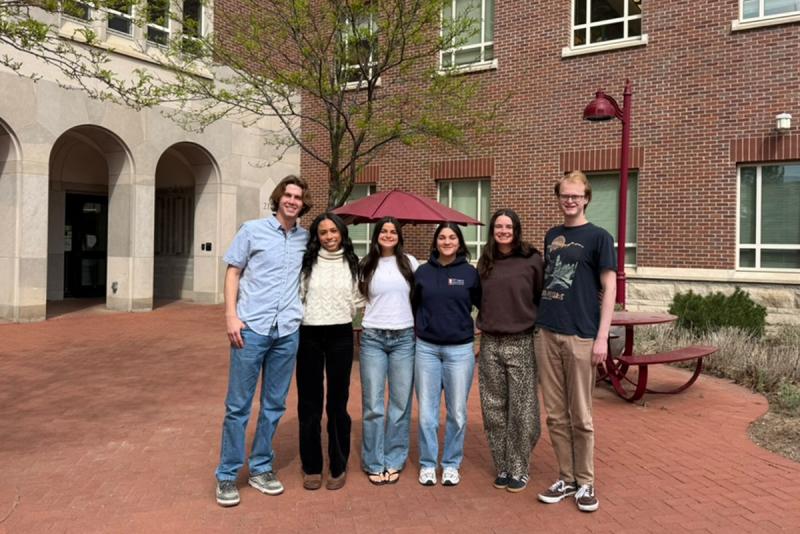
Aligned by Design: Redefining the Accuracy of Non-Robotic TKA with the Adante Alignment Attachment
Sponsor: Mizuho OSI (Daren Deffenbaugh)
Team Members: Josephine Trueblood, Lilyanna Conrad, Zyanya Burgos Resendiz, Talayah Biallas, Ashton Taylor, Alden Cantara
-
Read Project Information
Mizuho OSI has taken on the challenge to create a patient positioning platform that is well-equipped for total knee arthroplasty (TKA) - the Adante Orthopedic Surgical Platform. Currently, many TKA alignment techniques utilize navigational or robotic techniques, which often drive up the cost and accessibility of TKA surgery. Our team was presented with the challenge to create a non-navigational, non-robotic, alignment attachment to the Adante Orthopedic Surgical Platform that is customizable to the anatomy of the patient. This solution is also surgical technique agnostic and implant agnostic.
The Adante Alignment Attachment is a system that attaches to the footplate of the Adante surgical table during TKA surgery. The system aligns with the mechanical axis of the tibia, aligns the proximal tibia cut, aligns the distal femoral cut, and allows for the implementation of tools to make these cuts. The system also has the potential to make femoral resection cuts.
The major components of this design include the table attachment that fits within the footplate of the Adante Orthopedic Surgical Platform and is removable. The table to tibial connector attachment clamps into the table attachment and is detachable. The tibia height adjustment rod allows for a broad range of potential heights and attaches to the cutting block component. The cutting block allows for continuous angular adjustments that consider varus and valgus knees through a unique feature of gears that can be manually adjusted to allow for rotation. Attached to the cutting block is the stylus – this identifies the furthest point on the tibia and is used as a reference for the proximal tibia cut. The femoral attachment can be attached to the tibia height adjustment rod to put the cutting block in a position to make the distal femoral cut while remaining in line with the mechanical axis of the patient.
This all-in-one system that aligns and makes cuts during TKA surgery is unprecedented. The absence of intermedullary methods of alignment decreases the likelihood of further medical issues related to the impacts of TKA surgery. This system could reduce the cost of TKA surgery and prevent the need for expensive robotic or navigational technology – both of which make this surgery more accessible to both patients and doctors.
Sierra Space Team
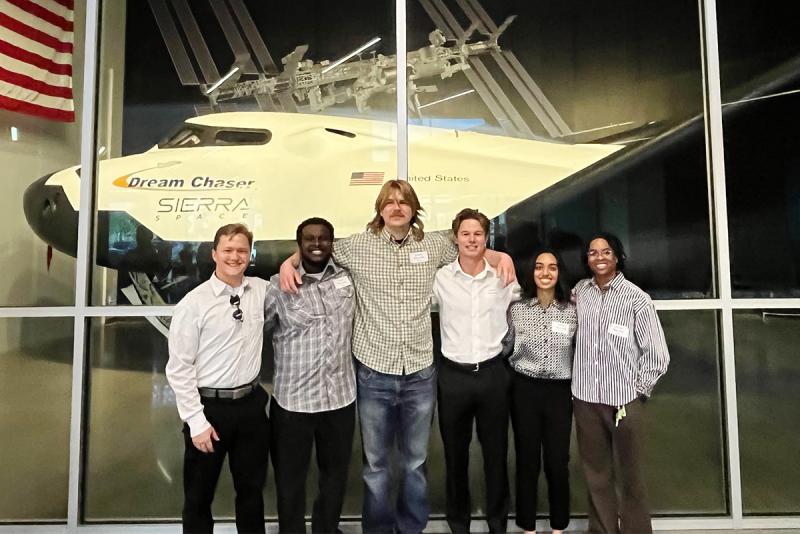
In-Flight Heat Shield Separation
Sponsor: Sierra Space
Team Members: Brody Doherty, Hassan Hassan, Evan Miller, Cora Rhodes, Prachi Shah, Adam Zolezzi
-
Read Project Information
This project aims to build and validate a proof-of-concept design that allows for clean separation and translation of a payload through a heat shield. This system is meant to be integrated with Sierra Space’s Ghost, which is a system designed to be able to deliver payloads globally within 90 minutes. Our design consists of a pin and latch mechanism that separates the payload from the heat shield when initiated through a servo motor. Eight V-shaped rails guide the payload through the opening in the heat shield to prevent binding. As the system falls and suspends underneath the heat shield, four integrated spring-based braking systems prevent excessive shock on the payload. A custom testing apparatus was designed and built to evaluate the final scaled-down prototype at various pitch and yaw angles. Results demonstrate that the proposed design achieves smooth payload translation, simultaneous separation, and effective shock mitigation. Additionally, the functionality of the design at its full-scale was verified through SolidWorks simulations, ensuring it can be easily integrated into Sierra Space’s Ghost system.
Solenic Team
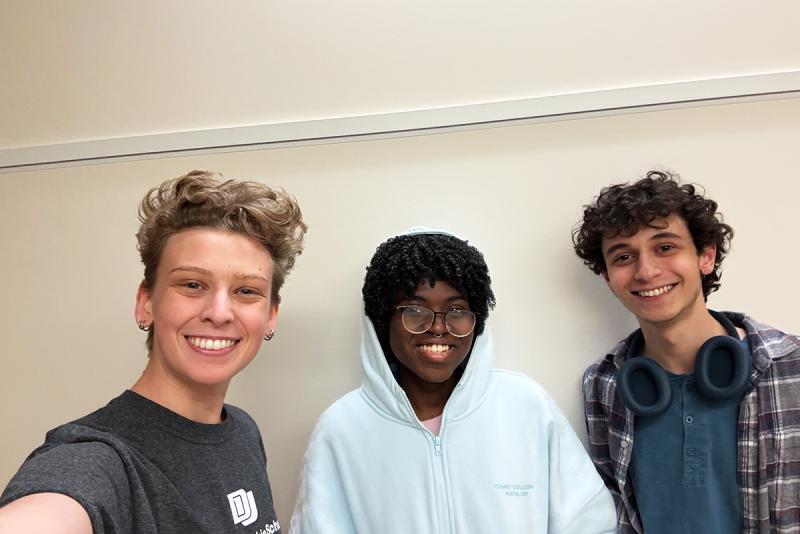
Knee Implant Temperature Measurement Rig
Sponsor: Solenic
Team Members: Barakah Kasule, Eli Leshtz, Kai McManus
-
Read Project Information
To treat post knee replacement infections, Solenic developed an electromagnetic system to heat the implant to 70 degrees C. It has been scientifically proven that heating to this temperature breaks down the bacterial film that forms around implants when infectious material is present. Though the output of the alternating current needed for heating can be estimated, this is still not an accurate method of getting the exact temperature.
The team’s primary objective was to create a temperature measurement rig capable of accurately monitoring the temperature of a knee implant during heating. For demonstration purposes, an imitation leg assembly containing polyurethane bone, agar-based muscle tissue, and silicone skin was developed to simulate heat transfer through the human body. Flexible polyimide heating pads were used to recreate Solenic’s inductive heating method, while four MLX90614 non-contact infrared sensors continuously monitored implant temperature in real time through a TCA9548A I2C multiplexer. An ESP32 microcontroller processed the sensor data and implemented a closed-loop temperature control system. Temperature readings from the infrared sensors were continuously compared against the desired temperature, allowing the controller to automatically activate or deactivate the heating pads to maintain stable implant heating and reduce the risk of overheating. System testing validated stable sensor communication, repeatable temperature measurements, and reliable heater control throughout sustained heating operation.
This heating process is revolutionary for infection treatment since it is noninvasive, greatly increasing the chances of long term recovery in patients. By being able to measure the temperature, the probability of complications caused by burns would be greatly reduced. In addition to this, temperature tracking allows doctors to verify that the heating is at the appropriate temperature for the treatment to be successful.
Trauma & Orthopaedics Research Charity Team

Smart Sensor Spacer Block for Measuring Knee Joint Balance in Total Knee Replacement
Sponsor: Trauma & Orthopaedics Research Charity
Team Members: Melaku Saketa, Abdullah Bohamad, Nyack Hartley, Sebastian Posada
-
Read Project Information
Total knee replacement (TKR) is a common surgical procedure, but achieving proper joint balance during surgery remains a significant challenge. In collaboration with the Trauma & Orthopaedic Research Charity (TORC) and Dr. David Beverland, this project addresses the lack of real-time, quantitative measurement during knee balancing. Current methods rely heavily on the surgeon’s experience rather than objective data, which can lead to uneven load distribution and negatively impact patient outcomes. The objective of this project was to design and develop an instrumented spacer block capable of measuring force distribution within the knee joint during testing, while also estimating the center of pressure.
To address this problem, our team developed a sensor-integrated spacer block system that uses thin force sensors embedded within a custom-designed casing. The system collects real-time force data and wirelessly transmits it to a user interface, allowing researchers to monitor load distribution throughout the range of motion. The design process included iterative prototyping, CAD modeling, and validation testing to ensure the system met key requirements such as size constraints, force measurement range, and durability.
Testing and analysis were conducted to evaluate system performance. Results demonstrated that the device can consistently measure medial and lateral force differences and provide insight into load shifts during joint movement. These results support the system’s ability to estimate center of pressure and evaluate knee balance more quantitatively compared to traditional methods.
The anticipated impact of this project is to provide researchers and clinicians with a more reliable, data-driven tool for studying knee balance in TKR procedures. By improving the understanding of force distribution, this system has the potential to support better surgical techniques, improved implant positioning, and enhanced patient outcomes. This project also demonstrates the integration of mechanical design, sensor systems, and data acquisition in a biomedical engineering application.
Thank You To Our Sponsors