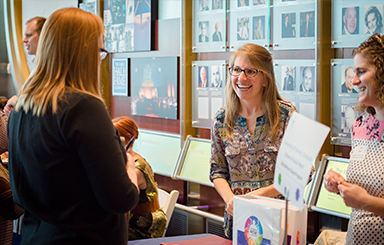
Register for the Colorado Future Systems Policy Showcase and Happy Hour on September 23, 2026.
Register Today
"Having an evidence-informed testimony that did not have any financial conflicts of interest, we thought would help contribute to the broader conversation," says Dr. Xie.
Through the project, Cody discovered significant public confusion about both the impacts of data centers and the strategies available to mitigate those impacts. He found that many existing policies and legislative proposals fail to address concerns such as noise pollution, air quality, and other environmental challenges.
"Find out as much information as you can," says Cody. "Ask questions about their cooling methods, how they generate their electricity, and whether or not they’re going to address noise concerns."
According to Dr. Xie, not all data centers are the same. Facilities vary significantly in size, purpose, and environmental trade-offs. Traditional telecommunications and communications data centers, for example, are generally much smaller than AI data centers.
"A more expensive data center might use less water but more energy," says Dr. Xie. "The data centers which are cheaper to build often rely heavily on potable water for evaporative cooling, which is particularly challenging given the water scarcity issues we're currently facing and are likely to face in the future."
Beginning in January, Dr. Xie will collaborate with the Denver Museum of Nature & Science's Institute for Science & Policy on a project designed to support Colorado state legislators as they consider future AI-related policies. As part of the initiative, the team will host AI policy workshops for elected officials, providing research-based insights on issues ranging from data center development to broader AI governance.
The project is funded by the University of Denver's Center for Community Engagement.
At the local level, Dr. Xie has also begun working with community advocates and residents to explore opportunities for collecting baseline environmental data. The goal is to better understand how the facility may affect the surrounding environment and neighborhood over time.
"Based on Cody's research, we figured out that there’s concerns related to noise pollution, water pollution, soil pollution, air pollution, and excessive heat," says Dr. Xie. "So, we’re trying to figure out if we can conduct baseline environmental measurements as well as perspectives from community members and see how they might be affected after the data center gets turned on."
The long-term goal of the project is to ensure the findings are shared with community members, not just academic and research spaces.
"We want to make contributions to research and academic communities, but we also want to make sure there is mutual benefit for the community members and partners we get to work with," Dr. Xie says.
Looking ahead, Dr. Xie envisions a future where students with various computer science expertise are tracking bills, engaging with lawmakers, and contributing to research for public good. For students interested in computer science, he believes the field offers opportunities far beyond software development.
"Computer Science is not only meant to lead to a career in the computing profession. At the Ritchie School you’ll not only develop a strong technical skill set to make you competitive, but you’ll also develop social and ethical perspectives needed to understand how technology affects people and communities."