Building on a Dream: The Road to Pikes Peak
DU’s Time Attack Racing club is gaining on its goal of competing in the “Race to the Clouds” at Pikes Peak in 2027.
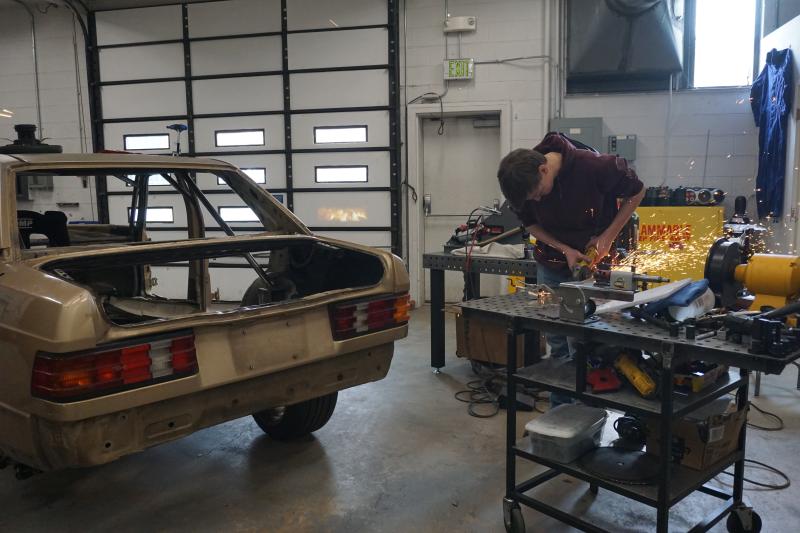
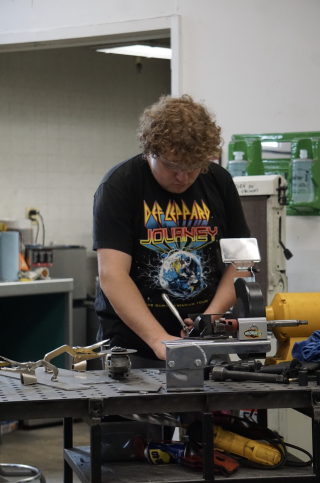
Fourth-year student Jackson Bolinger works on parts for a Mercedes 190 that Time Attack Racing plans to race at Pikes Peak.
Malcolm Morris-Berlin and Jackson Bolinger spend a lot of their free time in a garage. The fourth-year mechanical engineering students serve as fabrication managers for Time Attack Racing, a student club launched in 2024 by Club President Remington Stagg. Today, they’re all in the garage of the metallurgy building, cutting and welding parts for a stripped-down Mercedes that sits in the center of the room.
“We’re in here eight hours a day, two to three days a week,” says Morris-Berlin. “It’s fun. I’m in here with some of my best friends, trying to do something really cool.”
That “something” is the Broadmoor Pikes Peak International Hill Climb, an annual 12.4-mile race to the top of “America’s Mountain” with more than 150 turns and a finish line above 14,000 feet. Since 1916, racers have come from around the world to complete the course one at a time. Nowadays, top competitors typically reach the top in nine to 10 minutes. The record, set by Romain Dumas with an electric Volkswagen in 2018, is just 7:57.
Time Attack Racing is not coming for the record, or even the podium. Their goal is simple: to be the first college car at the starting line. The Ohio State University has successfully raced a motorcycle at Pikes Peak, but no college team has competed on four wheels.
“Our plan is to get this car to exist,” says Morris-Berlin. “The next generation of students are going to make this car fast.”
The frame has existed for some time—it’s a Mercedes 190 from the 1980s. But building a racecar isn’t easy, and Pikes Peak isn’t your average racecourse. Racing officials require all cars be driven by a professional driver and pass an inspection before they attempt the mountain’s tight turns. Time Attack Racing found its driver early in alumnus Matthew Butson (MS ’24), but the past couple years have been spent acquiring parts, testing designs, and checking off a list of safety requirements, including a roll cage around the driver’s seat.
Bolinger and Morris-Berlin say the cage, bent into shape from a long piece of metal, keeps the driver inside and prevents the frame from collapsing in on them in the event of a crash.
“This is the strongest part of the car…which is why it’s taken us a long time to get this cage finished—it has to be perfect,” says Morris-Berlin.
The journey ahead
Time Attack Racing had initially planned to race in June 2026 but decided to change its target date to next year to give it time to perfect the details.
Morris-Berlin estimates the entire project will cost between $100,000 and $120,000—and while those numbers might sound small compared to the budgets of companies like Volkswagen or Ford, it’s an ambitious goal for a group of students. So far, the team has secured a sponsorship from Mercedes-Benz of Denver, which is supplying the engine and brake kits. It also received an electronic control unit, the car’s “brain,” through a partnership with the competitive racing company Haltech.
Bolinger says they’re getting things done piece by piece with a combination of private donations and personal funds.
“[Building a car] takes an absurd number of hours,” he laughs.
“A lot of it is just trying things,” adds Morris-Berlin. “You come in here every day, find something to put together, and take a step forward.”
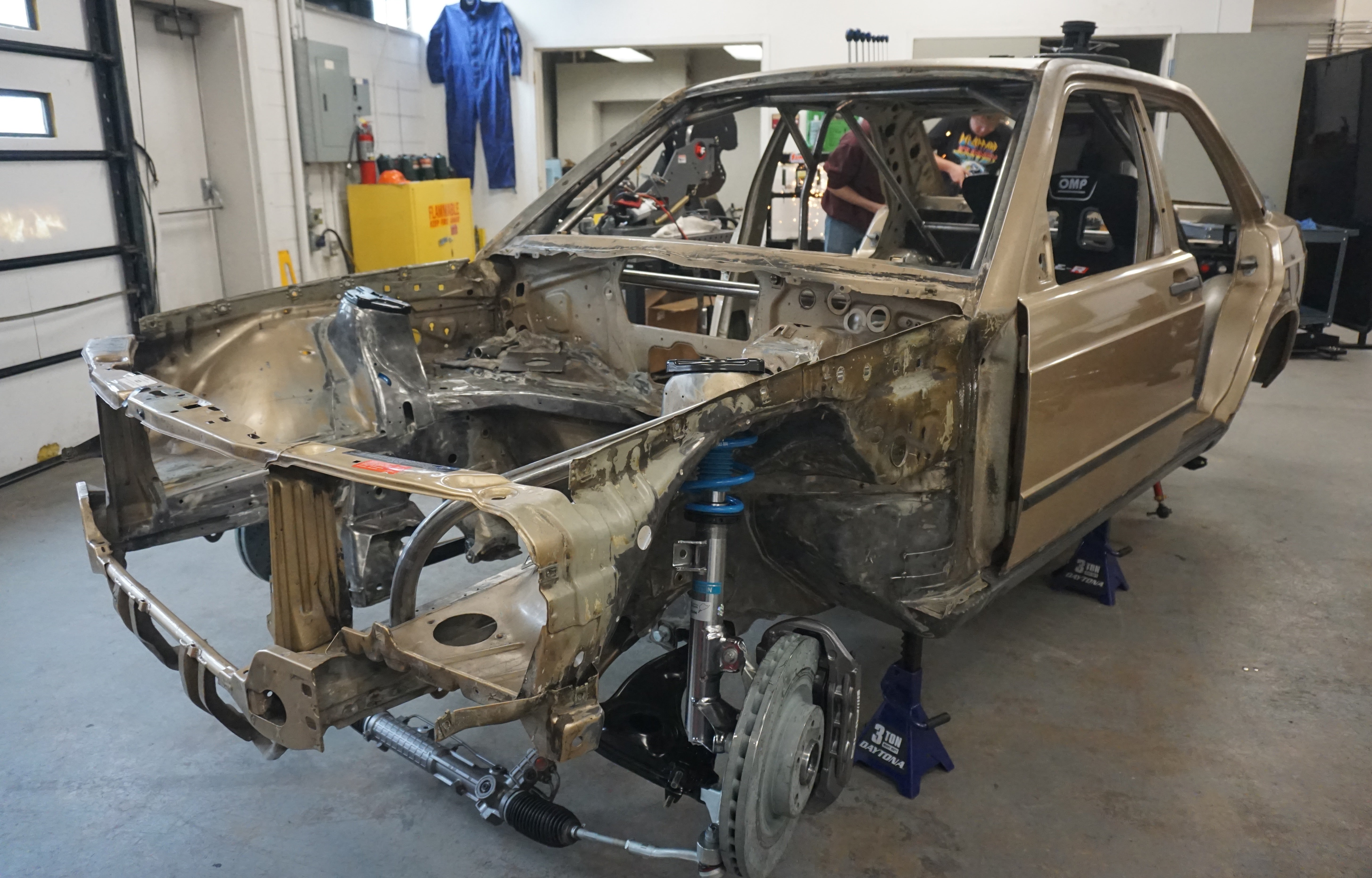
With major safety items like the roll cage complete, the club is now focused on getting the car steering on all four wheels. They’ve also designed a wing and other aerodynamic elements, like a front splitter for the front bumper, to create the downdraft needed to “grip” the car onto the road.
Not all Time Attack Racing members have to be engineers. The club’s roughly 40 students also handle fundraising, workshop training, project management, and social media. Paige Olson, a first-year marketing student, runs the club’s media and marketing team. She says it’s been a cool way to merge her studies with a longtime interest.
“I’ve always liked cars, and this is just a unique thing that a lot of colleges don’t have,” says Olson. She adds she’s excited to see where the project goes. “We’re in a good spot right now. We can start testing and getting into the racing aspect soon, rather than the build.”
In the meantime, Time Attack Racing does have a race on its calendar this year: The Denver edition of the Red Bull Soapbox Race. Competitors will race downhill in zany, nonmotorized “cars” at Empower Field on June 13. Morris-Berlin says the light-hearted event will be a chance for the club’s younger members to practice their skills as some of the founding members prepare for graduation.
You can learn more about Time Attack Racing’s mission here.